
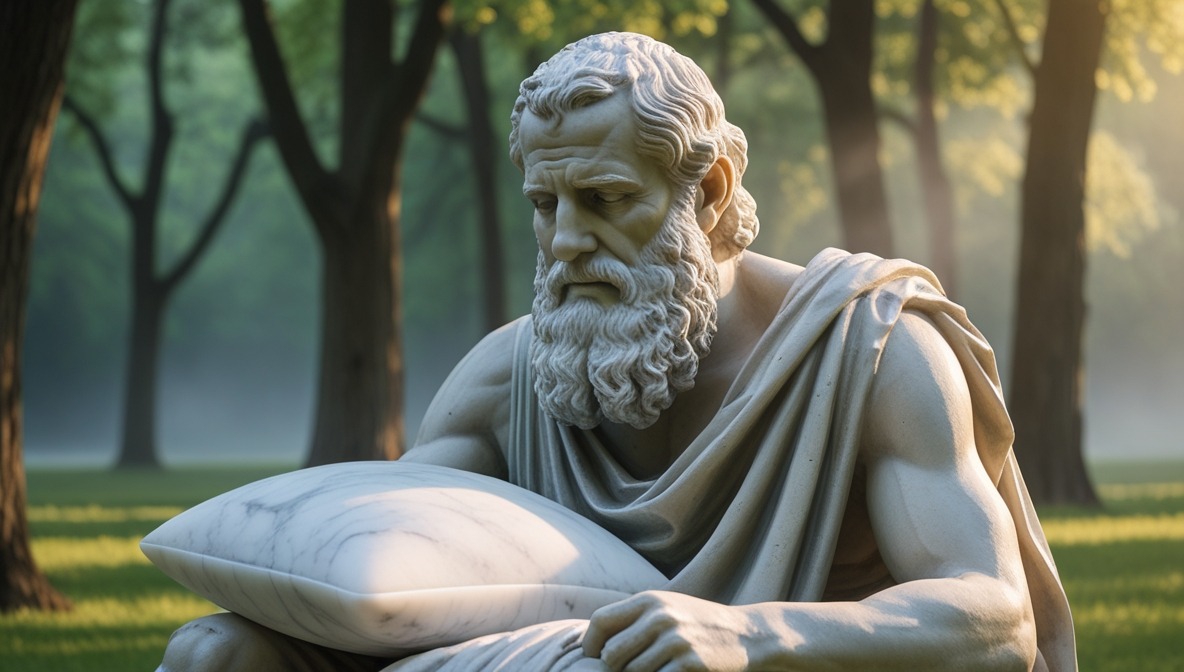
American philosopher Devin Bostick argues that Lucid dreaming can be structured as a mathematical model. The author is not directly involved with the subject of lucid dreams and has not conducted experiments; he is more of an advocate for abstract reasoning. He promotes his CODES model, which represents the world as a system of patterns that govern everything from artificial intelligence to lucid dreaming.
Imagine a radio. In a normal dream, we catch random snippets of phrases and music, but nothing is coherent. In waking life, we are tuned to a clear frequency; we hear a distinct program and know what is happening. In a lucid dream, we suddenly realize that we are sitting at the console of this radio in the dream—we can switch stations, adjust the volume, and even create our own broadcasts. The CODES model is an instruction manual for our consciousness that is designed to tune the system (“radio”) to the correct frequency so we can think clearly and control the situation.
The CODES system incorporates several key concepts:
1. Consciousness tuning—If it is clear, we are well aware of ourselves and the world. If it is poor, we are confused and have a poor understanding of what is happening.
2. Reality gate—This is like a filter that checks how well our thoughts correspond to reality. If we see an elephant in the room, the “filter” says, “This cannot be!” In a lucid dream, this filter is slightly weakened, so we can see incredible things and not be surprised.
3. Echo (feedback)—Our thoughts generate other thoughts, and our actions have consequences. In a lucid dream, we can “hear the echo” of our thoughts and actions, which allows us to control the dream.
It is important to understand that, for now, these are abstract arguments. The author is merely speculating about how this could be used in practice. For example, a special program based on artificial intelligence could analyze EEG data, track states of sleep, recognize imagery from dreams, and help the person make the necessary tuning in order to control the plot.
What do you think? Can philosophers bring practical benefits to the field of lucid dreaming?
The preprint of the article was published in June 2025 on PhilPapers.
Get all the latest news about lucid dreams via our channels on Telegram, Facebook, Twitter


