
A team of scientists led by Çağatay Demirel has taken another step in understanding what happens in the brain during lucid dreams. The team included such well-known researchers in the field as Kristoffer Appel, Sergio Mota-Rolim, Martin Dresler, Daniel Erlacher, and the legendary Stephen LaBerge. A preprint was released a year ago, and now a scientific journal article, with some revisions, has been published.
The authors recruited 26 lucid dreamers and studied EEG data at different sleep stages. They found that beta activity in the right parietal region—which is responsible for spatial orientation and self-perception—decreases during lucid dreaming. In addition, when a person realizes they’re dreaming, the gamma range is activated in the temporo-occipital region. And, most interestingly, the “connection” at the alpha frequency is enhanced between different brain regions, as if they begin to communicate more effectively with each other.
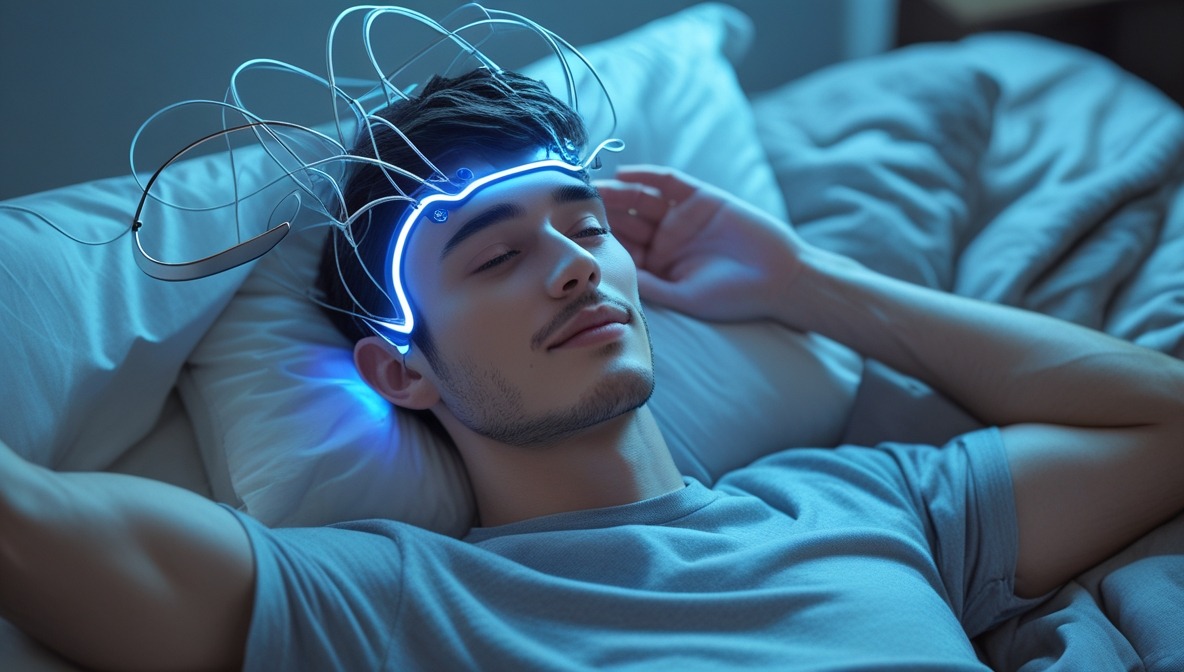
The scientists believe that these results open the door for creating new lucid dreaming methods—perhaps, we will one day be able to “turn on” lucid dreams using neurofeedback and brain-computer interfaces. Ultimately, there will be concrete, practical benefits—for example, helping people suffering from nightmares or post-traumatic stress disorder. Everyone will be able to control their dreams and heal trauma.
What do you think—will this information become a “magic button” for lucid dreams?
The article was published in April 2025 in the Journal of Neuroscience.
Get all the latest news about lucid dreams via our channels on Telegram, Facebook, Twitter


